
Munich Startup: What does your startup do? What problem are you solving?
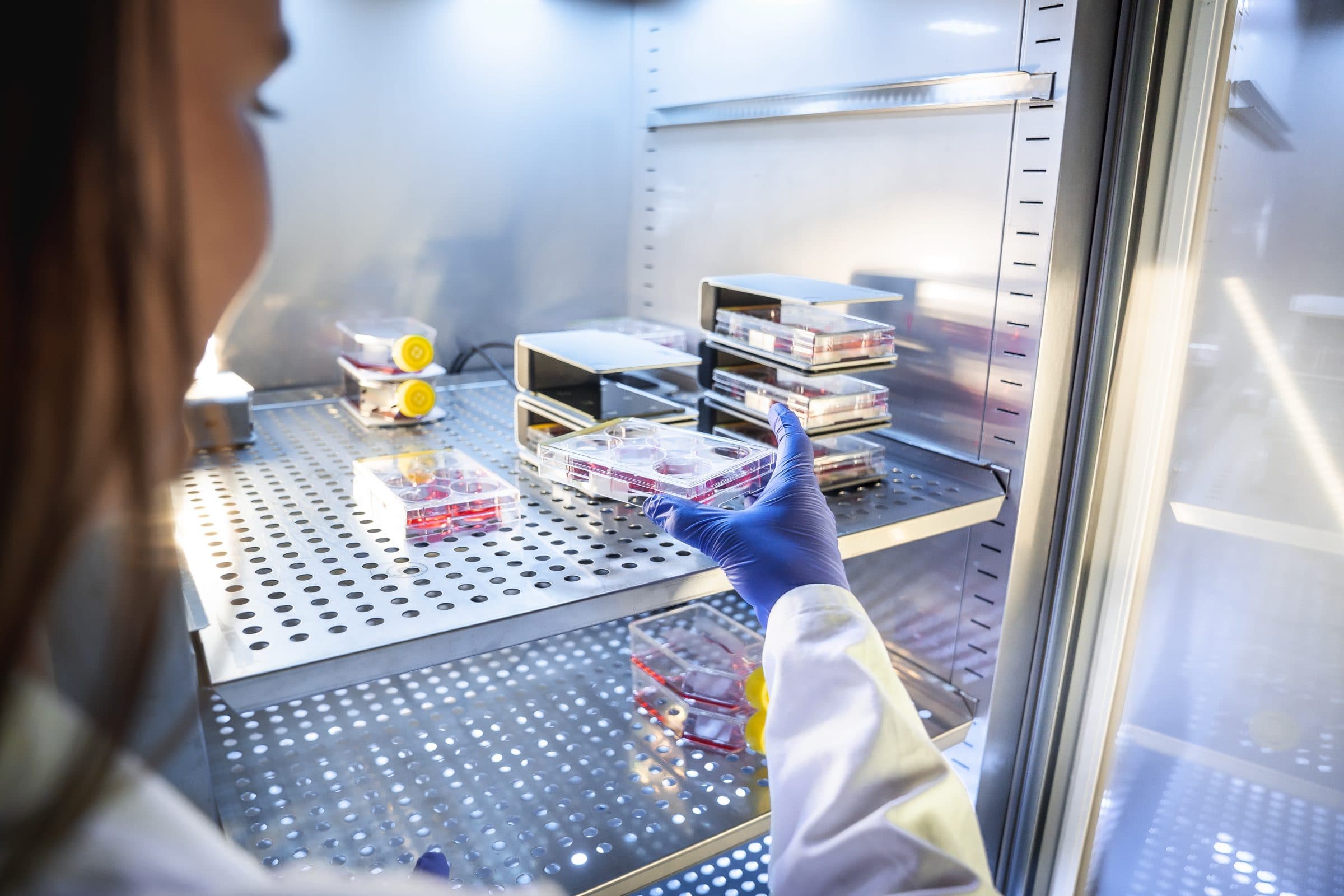
Daniel Gruber and Anna Jötten, Phio Scientific: Phio Scientific makes cell research faster, more precise, and more efficient. We develop AI-powered analysis systems for in-vitro experiments in the life sciences industry. Our users, usually scientists in cancer research and drug development, can use our system directly in the cell incubator and continuously observe and analyze experiments there. A specially trained AI segments and quantifies every cell image in real time. This way, we replace manual, sporadic, and often tedious collection of snapshots with a digital 24/7 data stream that massively increases reproducibility, throughput, and data quality in cell research and early drug development.
Munich Startup: But that already exists, doesn’t it?
Daniel Gruber and Anna Jötten: While systems with conventional lens optics, additional hardware, and endpoint measurements do exist, they do not offer our patented lens-free imaging procedure, which enables continuous, non-invasive measurement and forms the basis of our AI analysis. Our approach differs in three ways:
- Lens-free imaging provides up to 100 times larger field of view without loss of focus
- our AI analyzes in real time and delivers immediately usable data
- the compact device fits into any CO₂ incubator without modifications and installation effort
Result: More data, less space, no handling artifacts. Even with 3D cell structures, such as organoids, our technology offers great potential and contributes to the reduction of animal testing.
Phio Scientific: a solution for all cell research
Munich Startup: What’s your founding story?
Daniel Gruber and Anna Jötten: Our CEO Philipp Paulitschke developed the first prototypes in his research group at the physics faculty of LMU München initially for monitoring his own cell experiments. With the vision of making this solution accessible to all research, he successfully applied for EXIST funding for the founding phase and recruited collaborators from various disciplines to scale the technology for better, faster, and more reproducible cancer and drug research.
Munich Startup: What have been your biggest challenges so far?
Daniel Gruber and Anna Jötten: The outbreak of the Covid pandemic in our founding year 2020 made it difficult to fulfill many customer orders and limited the launch of the Cellwatcher through restricted marketing opportunities. We responded flexibly, shifted sales to digital channels, and successfully conducted customer acquisition and product demos via Zoom.
Munich Startup: Where do you want to be in one year, and where in five years?
Daniel Gruber and Anna Jötten: Several new product variants are about to launch in the coming year. Following this trend, we plan to scale internationally over the next five years while expanding our platform with additional hardware modules and AI applications to open up further market segments and fields of application.
Strong Munich biotech scene
Munich Startup: How have you experienced Munich as a startup location so far?
Daniel Gruber and Anna Jötten: The biotech scene is excellently networked, public funding and LMU offer excellent support. We benefit from mentors who have themselves built successful biotech startups and some of whom also come from the physics faculty of LMU.
Munich Startup: Hidden champion or shooting star?
Daniel Gruber and Anna Jötten: In the long term, we want to improve research quality worldwide by setting new standards in reproducibility. Journals and editors constantly demand more solid, reliable data at scale. Our publications show, for example, that omics analyses are massively improved by controlling growth parameters. This is exactly where our technology can revolutionize cell research in the long term and we can become a shooting star.