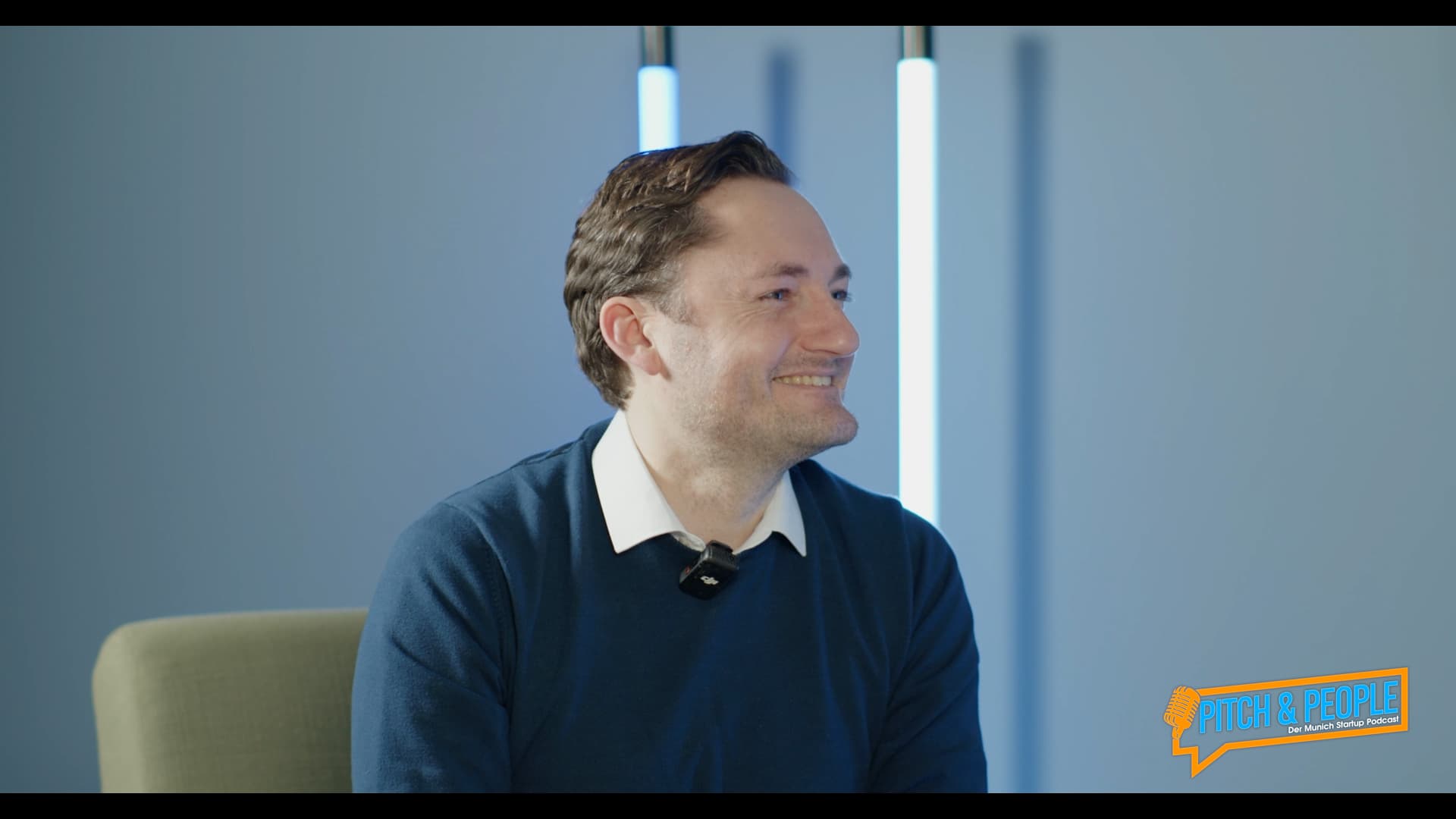

PITCH & PEOPLE Folge 12: Robert Richter
Why is Europe losing its tech champions – and why could Munich be the one to surge ahead right now? Werk1 CEO Robert Richter speaks at Pitch & People about a crucial turning point: while regulation and antitrust law are slowing down young companies, a new innovation district is emerging in the Werksviertel that aims to connect startups, scaleups, investors, and enablers more closely than ever before. Richter explains how Werk1 is to become a European hub with up to 300 startups and why Munich, despite global uncertainties, is heading toward a record year in 2025.


With its expansion to now 11,000 square meters, Werk1 is gradually developing into a comprehensive campus for digital entrepreneurs. Robert Richter, CEO of Werk1, describes the goal at Pitch & People like this:
“We’re planning a one-stop-shop in the Werksviertel where startups, scaleups, investors, accelerators, magazines and even municipal services work closely together. The idea is actually to create a district where we’ll have two to three hundred startups and scaleups by 2030.”
For this to happen, not only will the Werk1 itself continue to grow, but so will the surrounding area: a second MTZ specifically for scaleups is planned, and additional enablers like the Start2 Group and extra accelerators are expected to move into the district. The plan is to create an ecosystem where entrepreneurs only need to take a few steps for mentoring, financing, visibility, or administrative processes. Richter describes this vision as one large interconnected area that achieves efficiency gains, pools resources, and grows even stronger through shared event and meeting spaces – an innovation district that is set to become one of the most vital startup hubs in Europe.
Too few unicorns
Too many regulations, too little room to maneuver. In the video podcast, Robert Richter also talks about Europe’s missed opportunities. A central factor here is strict antitrust law, which prevents mergers and thus makes growth impossible.
“We hamstring ourselves every day in creating champions here, and in the end everything gets bought up by foreign companies,”
explains Richter.
Richter also sees a systemic problem when it comes to artificial intelligence. While the US gives young companies plenty of room to operate before regulating, Europe in his view sets constraints too early and too strictly.
“For example, the AI Act, where I want to regulate everything beforehand, and then somehow hope that a startup forms – that’s just unrealistic.”
Europe mistrusts innovation initially and creates too many regulations before a company can even develop.
The result of this policy is particularly visible in global competition: the US has created “about 800 unicorns in the last 20, 30 years,” while Germany has just 27. For Richter, a clear signal that the continent is handicapping its own growth opportunities. His appeal is therefore clear: Europe needs “strong guardrails, but spaces where creativity and entrepreneurship can develop freely.” Only then can the region play more ambitiously in international comparison and finally produce its own tech giants.
For startups to be internationally competitive, flexibility is needed. But labor law, reporting requirements, transparency registers, and other regulations slow down teams in their most critical phase. Founding teams therefore need the opportunity in certain moments to “work 60, 70 hours a week” if necessary. Not permanently, but situationally and voluntarily.
Why Munich is still booming
Despite economic slowdown, global uncertainties, and a regulatory environment that slows many startups, Munich is experiencing remarkable momentum according to Robert Richter. He even says that 2025 is proving to be an exceptionally strong year for founding and investment. While recent years have been rather subdued, Werk1 is now registering a noticeable upswing:
“We have significantly more founding activity this year than in recent years,”
says Richter.
At the same time, the Munich location is still highly regarded by investors. The region has a reputation for being stable, reliable, and quality-oriented. An environment where risk capital is not easily lost. Despite global uncertainties, there is still plenty of capital in the market and interest rates are not high enough to deter investors from tech investments.
There’s also an interesting countertrend: economic downturns lead to more founding activity. When the opportunity costs for highly qualified professionals fall because entry salaries or secure job prospects become less attractive, interest in founding often rises.
Many people who have long considered starting their own business are now taking the plunge. Not despite the uncertain situation, but because of it. In parallel, there’s growing political will to tap new capital sources. Richter points to the state parliament’s decision to make it easier for foundations to invest in venture capital in the future. A step that, in his assessment, could mobilize additional private capital.
Munich is thus, despite all challenges, under an unusually positive sign: more founding activity, more capital, and growing willingness to invest in future technologies. According to Richter, the city could even achieve a record year for venture capital inflows in 2025.
The interplay of a strong ecosystem, growing entrepreneurial spirit, and political openness makes Munich for him a location that is currently performing exceptionally well in European comparison.