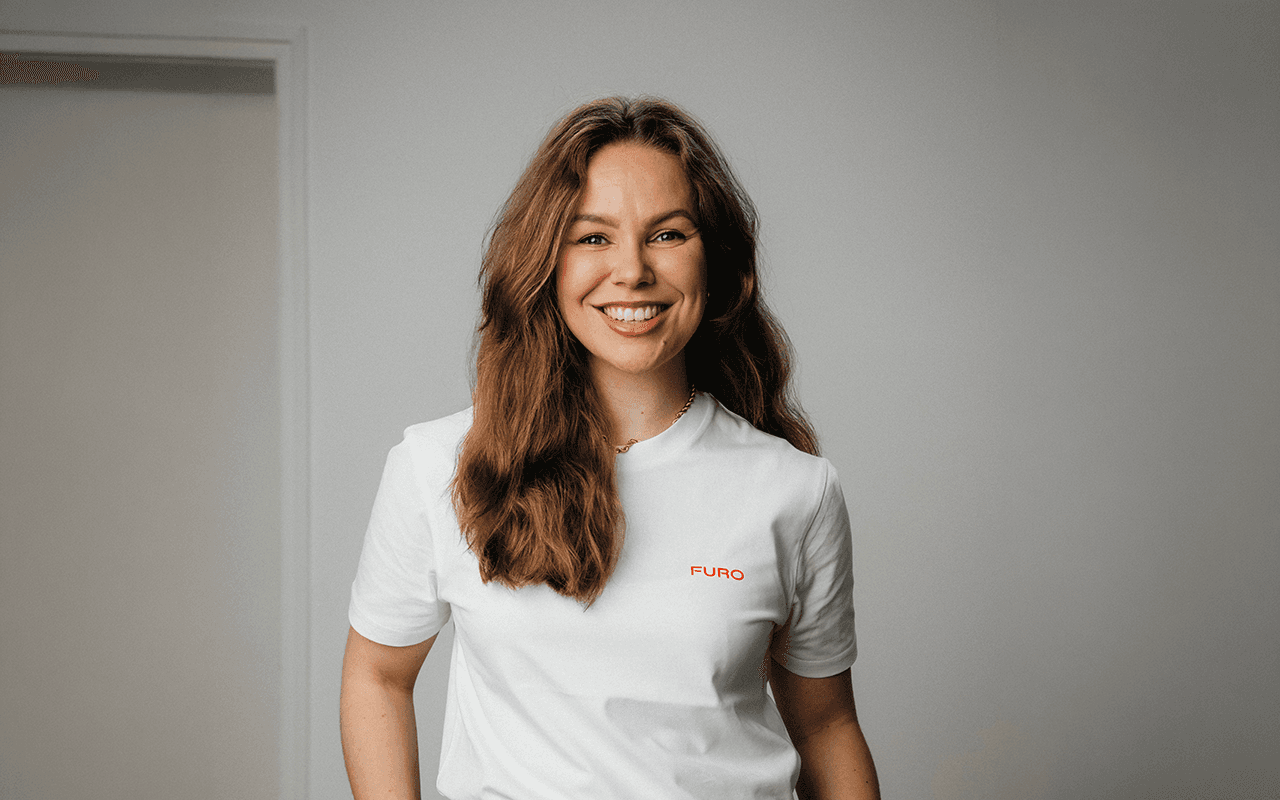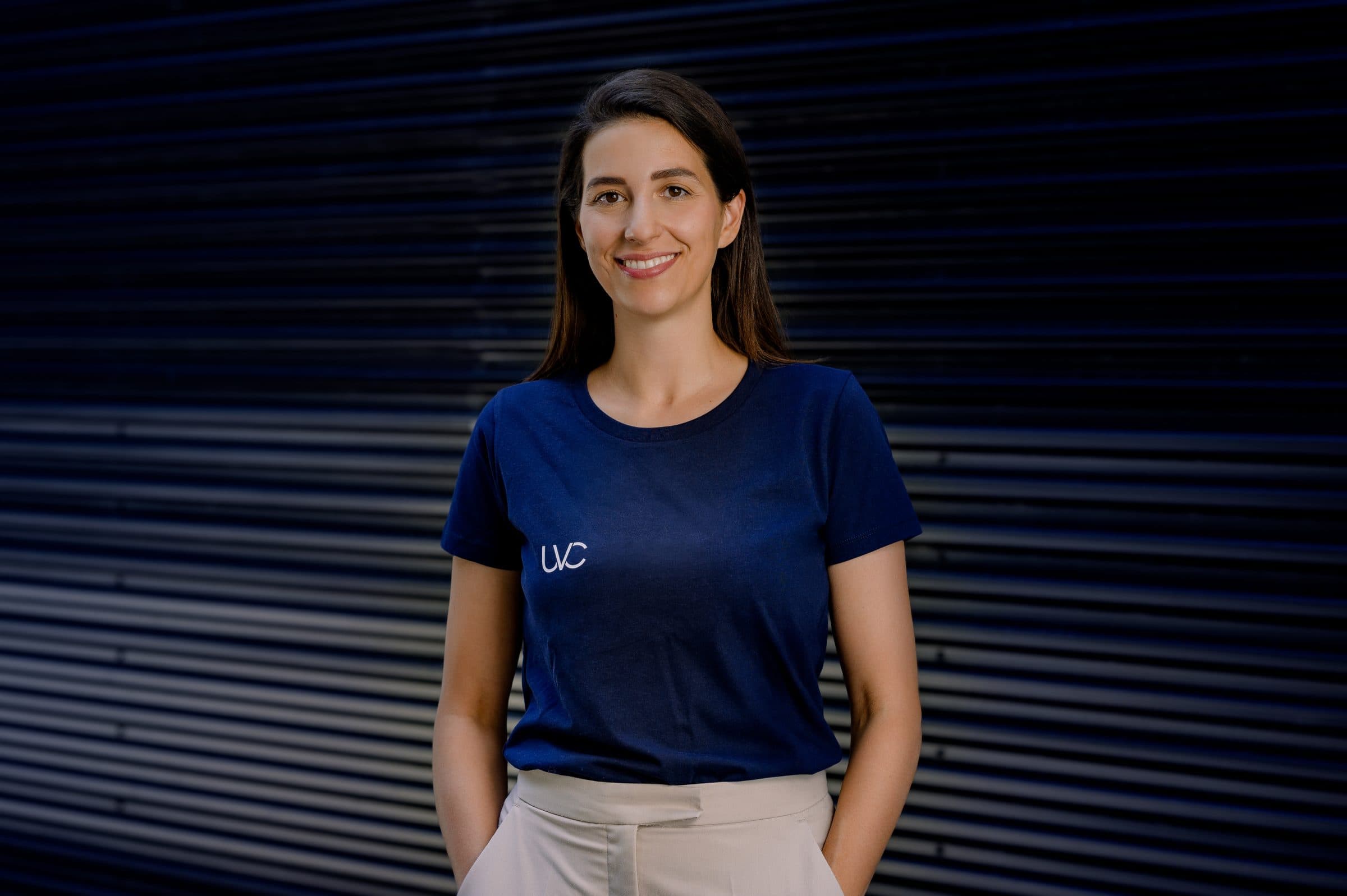

Munich Startup: Amanda, you work as an investment manager at UVC Partners. Before we get to that, could you please take us through your professional career so far?
Amanda-Stella Birkenholz: I studied industrial engineering with a focus on mechanical engineering at RWTH Aachen University and completed an international trainee program at Bombardier Transportation after graduation. Through that, I went through various stations in the company and was based in Berlin, London, and Bangkok, where I eventually spent two years helping to build the new headquarters for Asia. During that time, I worked closely with boards and realized that I didn’t want to spend my entire career in a large corporation.
In 2015, I moved back to Munich, where I grew up, and discovered the startup world for myself. Over the past few years, I worked at a company builder where I built B2B tech startups myself, and a year ago I switched to the investor side at UVC Partners.
Munich Startup: As you mentioned, you currently work at UVC Partners, the investment arm of UnternehmerTUM. Can you briefly introduce UVC Partners?
Amanda-Stella Birkenholz: UVC Partners is a spinoff of UnternehmerTUM and an independent VC fund with which we invest in B2B tech startups in Europe. Our focus is on industrial tech, enterprise SaaS, and mobility, and we make both hardware and software investments in pre-seed through Series A companies. Our third fund has €250 million in capital and we initially invest €0.5–10 million and can then finance up to €30 million per company in follow-on rounds.
Focus on hardware sectors
Munich Startup: What exactly does your work there entail?
Amanda-Stella Birkenholz: The scope of tasks is quite broad and covers everything from searching for exciting startups to overseeing them. Concretely, this means screening startups, conducting due diligence to understand products, technology and markets, and also assessing the team, making investment decisions with the team, negotiating contracts with startups, and subsequently collaborating through the board to make strategic decisions and support further financing rounds.
Munich Startup: What technologies or industries do you focus on?
Amanda-Stella Birkenholz: I am responsible for many hardware areas such as quantum computing, robotics, energy, space, and also proptech.
Munich Startup: Which startups have particularly impressed you recently?
Amanda-Stella Birkenholz: We recently announced one of my investments in the quantum computing space. We invested in Planqc, a company that comes from the Munich Quantum Valley and will build quantum computers that operate at room temperature. The team consists of world-renowned experts who bring extensive research experience in their field and are now using those insights to build a company. I am convinced that quantum computers will significantly change the world as we know it today, and I’m very excited to be part of that.
“Unconscious bias plays a role”
Munich Startup: There are still significantly fewer female investors than male investors, and according to the German Startup Monitor 2021, the share of female founders in Germany is less than 18 percent. Do you see a connection between these two aspects?
Amanda-Stella Birkenholz: Certainly, and there are various aspects to this. On the one hand, unconscious bias, which we all have and which is natural, plays a role. We connect better with people who are similar to us, and gender certainly plays a role in that. The industry is still dominated by male investors, so it’s not unusual that they see more potential in male teams that are similar to themselves. On the other hand, there is already a strong awareness in the industry that diverse teams perform better, which certainly means there are more opportunities for female founders to raise capital today than there were a few years ago.
The other very important point, in my view, is the network. Men’s networks are usually larger than women’s networks, which unfortunately is often crucial. There are already best practices in both company building and fundraising that increase success rates, and knowing these is very valuable. This is why networking with other founders is very important and also helps get introductions to VCs, which works much better than sending a pitch deck via a homepage.
Munich Startup: In your experience, do women invest differently than men?
Amanda-Stella Birkenholz: Women are often partners in impact funds, whereas this is unfortunately still rare in classic finance funds. I believe that in classic VC, the decision-making processes of women and men are similar, although women certainly have a different perspective on topics.
More bootstrapping, less VC
Munich Startup: And do women also found companies differently than men?
Amanda-Stella Birkenholz: Women often have a greater need to do something with impact. Because of this, and also because there are more female partners in impact investing, the share of female teams receiving funding from impact investors is significantly higher than from classic finance investors.
I also frequently observe that women focus more on bootstrapping and really want to build something solid before seeking financing. Men, on the other hand, raise money earlier and more often based on a vision than women do. Companies founded by women are therefore often more solidly set up, but don’t always have as strong growth as companies founded by all-male teams.
Munich Startup: Do you think special networks just for women are needed to motivate more women to found and invest in companies? If so, can you recommend any?
Amanda-Stella Birkenholz: I believe that women should network more overall and that a women’s network can be a good framework for openly discussing certain topics in a closed group. That’s why we founded the Female Founders Office Hours, where we offer support to female teams on topics such as financing, startup programs, and building startups.
However, the network must be gender-independent, and networking with successful founders and investors – who are still often male today – is what women need to build knowledge and gain access to customers or investors.
Unfortunately, too few women invest as well. Svenja Lassen founded the Female Investors Network to raise awareness among more women about angel investments and provide access.
Munich Startup: Work-life balance is an important topic for many women who want to found companies. In your view, what needs to change so that women who already have children or want to start a family are not deterred from founding a company?
Amanda-Stella Birkenholz: Some teams start founding directly after university. This has many advantages because you have low living costs and don’t yet know what isn’t possible. Then you just do what you think will work, and suddenly things succeed that no one else had managed before. However, many teams also found companies after gaining a few years of work experience and building expertise in a particular area. Then the founders are around 30 years old, and especially for women, the topic of family is usually very present at this point. Many want to have a family and think they need to put their career on hold as a result. The concept of parental leave is wonderful, but unfortunately most parents follow the model where the woman takes 12 months, the man takes two, and during that time they take a vacation in New Zealand or somewhere. Many women then work part-time and bear primary responsibility for their children. Building a startup on top of that is almost impossible, and is certainly one reason why many women shy away from it.
At the same time, most of the male founders I interact with have small children. For men, this aspect doesn’t seem to play as significant a role as it does for women.
Dividing childcare
For women who want to found companies, it is crucial how childcare is divided between parents and that men also take on a large share of the tasks and responsibility. Having the conversation early and bringing men more into the responsibility is essential. Because then you don’t have to make a compromise between founding and family; instead, you can combine both.
I myself also have a daughter, and my partner and I both work full-time. Our daughter is in daycare all day, is well integrated there, and is very happy. We divided parental leave equally, and in everyday life, he takes on just as many tasks as I do. Only as a team can we manage family and career and find a framework in which we are both fulfilled.
Munich Startup: Does it seem like a good time to found a company right now?
Amanda-Stella Birkenholz: I believe it has never been easier than today to build a startup. The ecosystem has evolved significantly over the past 10 years, there is plenty of capital in the market, and large companies now want to work with startups more than ever before. This is a big plus especially for B2B startups and helps tremendously in driving speed and growth.
There are many concerns that there will now be less money in the market for startups due to the Ukraine crisis. I think that despite an impending recession, there will still be enough financing options for good teams. In the past, we’ve also seen that innovations often arise during times of crisis.
Munich Startup: What do you think could still be improved about Munich as a startup location?
Amanda-Stella Birkenholz: Munich has become the center of startups in Germany. The first startup wave was in Berlin, where many B2C companies were founded at the time. Southern Germany in particular has a lot to offer tech startups, especially with its strong focus on industry and talent. UnternehmerTUM is now Europe’s largest entrepreneurship network and is a great place for startups to find themselves and grow.
A city with great quality of life where BMW, Google, and Amazon are located and pay very high salaries naturally comes with high cost of living, and I would like to see more support for affordable housing here. Greater availability of affordable childcare with long opening hours would also be desirable, because especially for female founders, family versus career should not be a compromise. But women also need more supporting conditions to make founding possible.
Role model: Spanx founder Sarah Blakely
Munich Startup: Which investor would you like to meet in person one day? And what would you ask them?
Amanda-Stella Birkenholz: Unfortunately, there are far too few role models. One of my role models is Sarah Blakely, the founder of Spanx. She built a billion-dollar company without capital or a background from an entrepreneurial family, heard many “no, that will never work” along the way, and today supports women in building their companies. What I find impressive is how single-mindedly she pursued her path, and what would interest me most is how she had the perseverance to keep going despite many setbacks.