
Munich Startup: The last time we spoke, you had planned your solution’s market launch for this year. You managed that in April, but with a slightly different product than originally planned. What exactly happened?
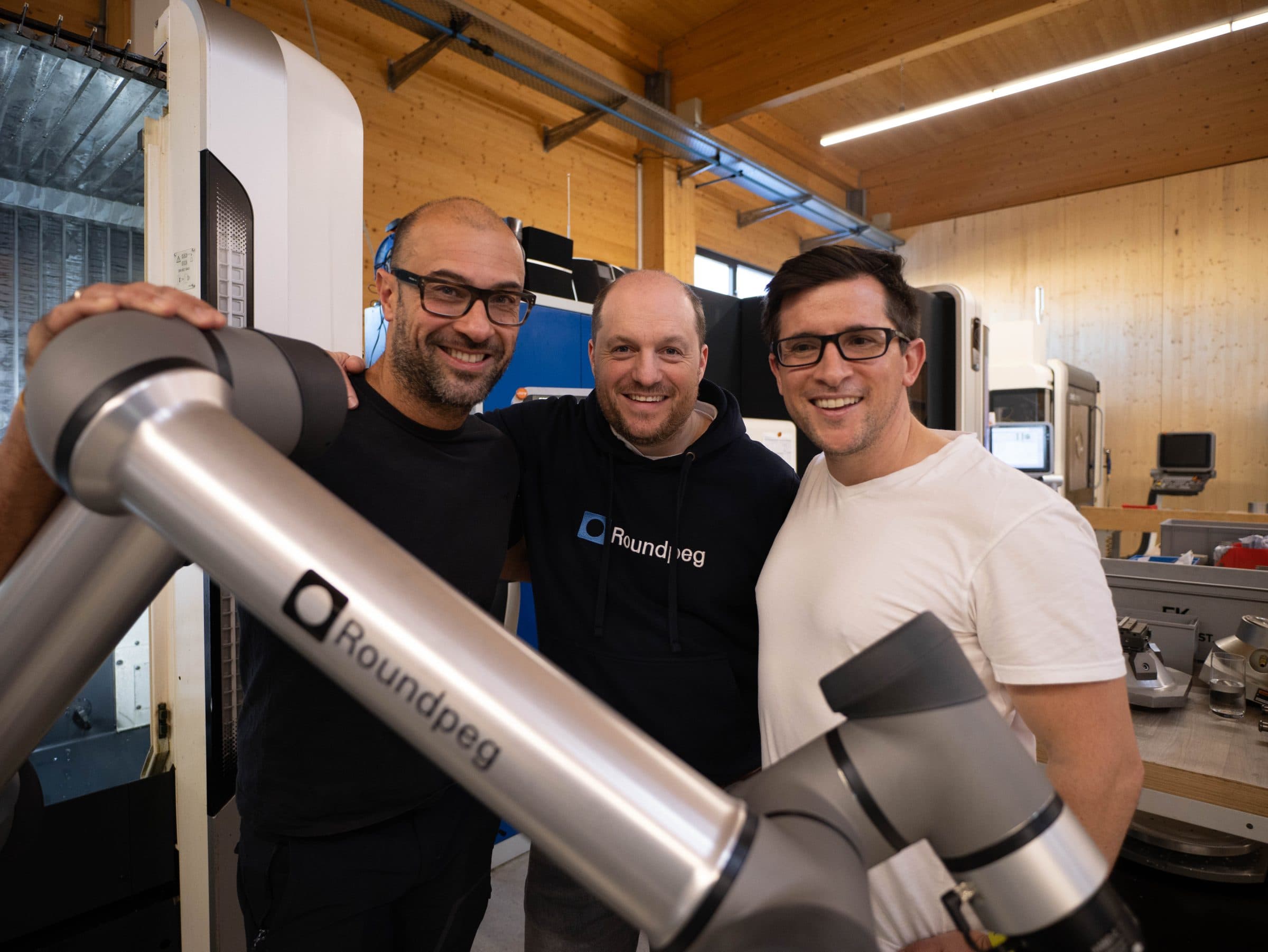
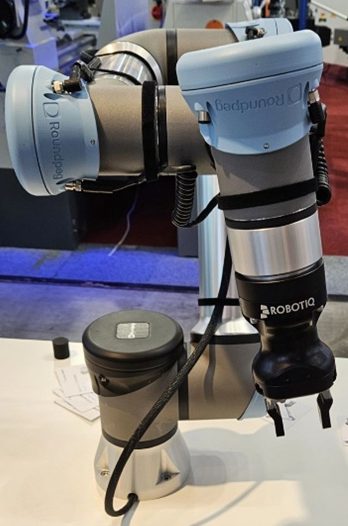
Roundpeg: When we last spoke, we still had a complete solution with a robot in focus. But since then, we’ve managed to adapt our product so that we can mount the sensors on already active robots. With its round sensor housing, our product is now actually a round block, or round peg, as you would say in English.
Munich Startup: What new challenges came up with the market launch?
Roundpeg: A new challenge now is of course always being able to deliver. This includes, for example, maintaining clean parts management. And we also have to be able to somewhat anticipate when orders will come. So to speak, all of this is now “normal business”: manufacturing facilities send us inquiries and want quotes, delivery notes, and eventually invoices. The robot has to arrive at the time it’s ordered. Now it all perhaps has less to do with the stereotypical image of a startup that we sometimes still have.
A revolutionary solution that needs explanation
But a much bigger challenge has been explaining verbally to customers what our product can do. Especially at trade shows, we encounter many people who initially can’t make much of it when we tell them that the robot stops on its own before it hits them. Especially those with little to no robot experience assume that this is simply how it works. When we then explain to them that the robot would have just hit them without our product, they initially don’t believe it.
With customers who have a lot of robot experience, it’s quite the opposite. They prefer to stand several meters away from the robot when talking to us. Then we present our solution, and as we talk, the conversation gradually moves closer to the robot. For these customers, it’s actually a surprise when the robot approaches them and then stops.
But it’s essential for us that all of this is understood correctly. Because it’s not just about preventing collisions. With this, we’re also changing and improving the way people work together with robots. And if someone already has a certain picture from their own experience of what this collaboration with a robot is like, they sometimes simply need to experience that it can be different.
“This has to get into people’s heads!”
Munich Startup: How does your future growth look?
Roundpeg: As I said, many are still used to the robot being behind a fence doing its thing. As soon as the cordoned-off work area is entered, the robot stops working. I either stand next to the robot, or the robot moves when I’ve left the cage. That both are possible – that’s what has to get into people’s heads. But now we have the opportunity to present one or another customer use case, for example with Airbus. When customers see that solutions exist and you can really stand next to the robot and it reacts to you – then that also takes on a certain momentum.
Munich Startup: How is your solution then received in factories and assembly halls? How do the people who ultimately have to work with the robots see all of this?
Roundpeg: The feedback we’re currently getting shows us that it’s a huge win for robot acceptance. It’s seemingly a small contribution, but it has an incredibly strong effect on how people in manufacturing facilities perceive things. This changes away from the dumb robot that might replace you. Instead, it’s seen more as a friend who respects you and who you can work with.
Munich Startup: And how are things looking financially for you? Are you looking for growth capital?
Roundpeg: We’re now in the pleasant position of having revenue, and that helps tremendously on the financial front. As for growth capital, we want to raise a round soon. We’ve found that we really solve a customer problem. Because: Our solution is currently the only one that can be retrofitted to a robot and truly avoids collisions. Worldwide. That’s why it’s a good opportunity to bring a strong partner on board and accelerate. There are even already a few commitments – so things are looking pretty good at the moment.
Roundpeg wants to revolutionize human-robot interaction
Munich Startup: How do you envision things developing for you in the future?
Roundpeg: Our vision is to revolutionize human-robot interaction in absolutely every respect. There’s still a strong focus on production robots because manufacturing companies are still the main purchasers of robots. But everyone in the industry is hoping for the private sector. And if we can solve it so that robots can truly perceive their environment cleanly on their own, that will be a strong accelerator for robots in our everyday lives. The goal – or the dream – is still for robots to handle the things around the house and in our everyday lives that are tedious. And our vision is to make a solid contribution to that by reshaping the interaction between robot and human.
Munich Startup: What learnings has your team been able to take away so far?
Roundpeg: No matter how well you know each other – we both knew each other long before founding the company – when you build a startup together, you get to know each other in a whole different way. But what might be more important for other founders: With potential future team members, we look very closely at whether they truly support our vision. And we also have to see how they can contribute to it. And you’re surprised at how effective even a small team can be these days.
Starting a startup is like a 1,000-piece puzzle
Munich Startup: What makes a good startup ecosystem for you?
Roundpeg: It’s really very valuable to exchange ideas with others. When starting a startup, there are so many concerns you have to address, and a good ecosystem provides input from all sides on what to watch out for. You might compare it to a 1,000-piece puzzle: You get all the puzzle pieces thrown at you and in the end a company is supposed to come out. But you have no idea how to put it together, and the ecosystem then provides, so to speak, the lid of the box that shows you what it should look like. That’s certainly not a precise instruction, but you do get lots of inputs that each move you forward a little bit. The good programs have understood that – but we think we should push it even more in Munich.